
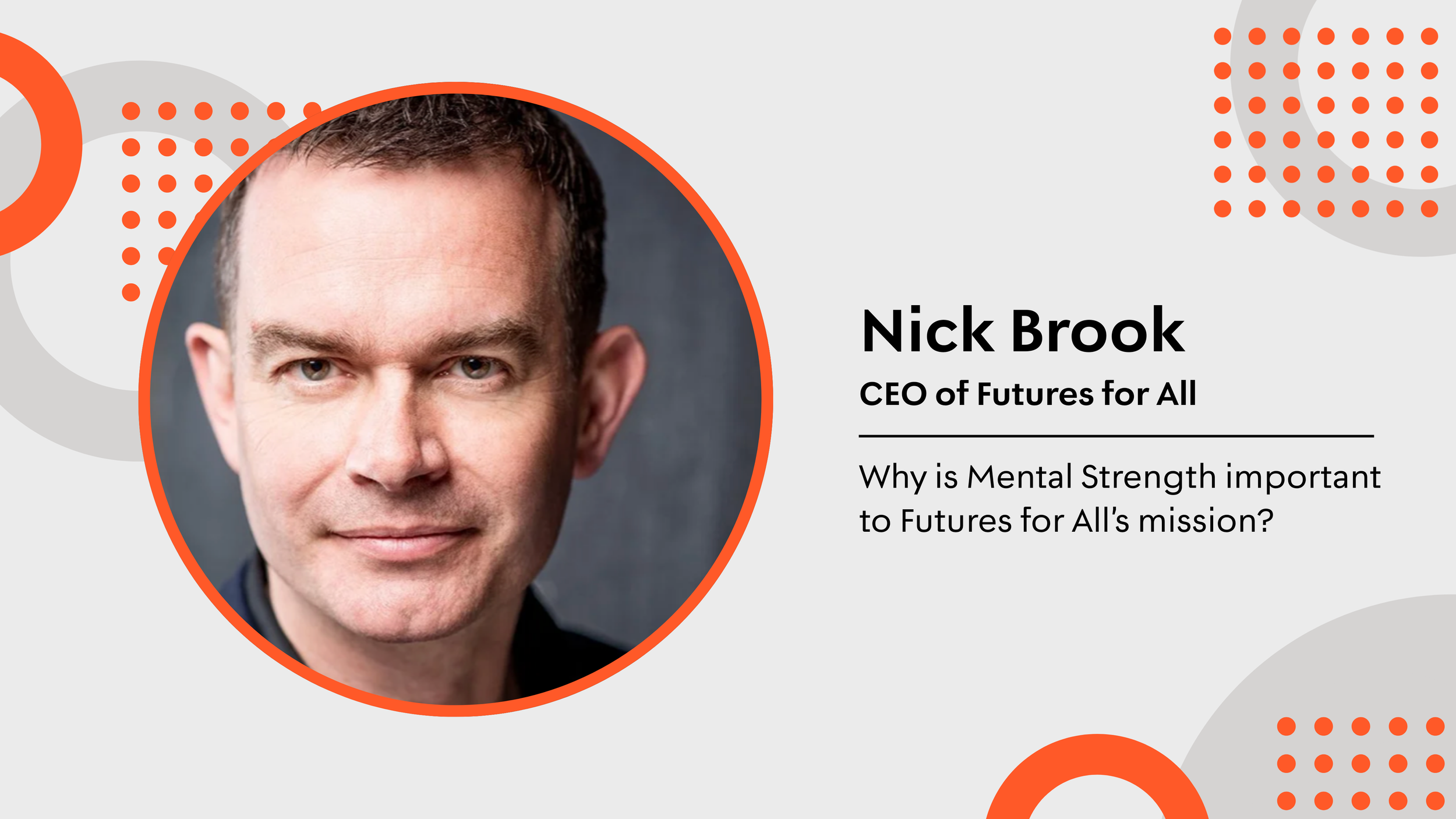
Insights from Nick Brook, CEO of Futures For All, on Why mental strength is important to their misson.
Our mission is simple – to level the playing field into the world of work for all young people.
Through the talks we provide we help broaden horizons and challenge assumptions about who succeeds in which careers; through work experience we change that inspiration into action. Equipping young people with the skills, attitudes and confidence to seize opportunities available to them is core to what we do.
Which is why HPF’s Mental Strength Research is so important to us and to schools. The findings around Mental Strength, resilience, confidence and mindset align completely with what employers tell us they are looking for from future talent and are core concepts in better preparing young people for the workplace.
The link between mental strength and work-readiness.
There is a strong, direct link between mental strength and work-readiness. When young people enter a real working environment they are often required to manage uncertainty, respond to set-backs, navigate new expectations and take responsibility – the very same qualities identified in this research.
Evidence shows that high-quality work experience placements help develop the very skills and attitudes valued by employers and identified in the Mental Strength research. We often see young people arrive to work experience unsure of themselves, yet within days they develop the confidence to speak up, ask questions and participate more fully. They practise professional communication, develop resilience when facing challenges and unfamiliar environments, and learn initiative when given tasks and projects. These changes are often profound and a powerful addition to what can be taught in a classroom.
Why measurement is a breakthrough.
Until now, these skills were widely recognised as vital but rarely measured in a rigorous or consistent way. HPF’s research provides a structured framework and shared language for describing mental-strength attributes. In the context of work experience, it provides a method of measuring and articulating what young people gain from placements – helping schools, employers and policymakers understand and demonstrate its true value.
Why I joined the High Performance Foundation Taskforce.
I chose to join the Taskforce because the ambition speaks directly to what Futures for All has championed for years. Our work has always gone beyond exposure to careers. It is about supporting young people to think differently about themselves and their potential. I firmly believe that youth development must be seen and understood not just as academic success, but through the wider lens of mindset, behaviour and character.
Looking ahead…
By combining High Performance Foundations’ research with our on-the-ground insights, we can design even stronger programmes: experiences that intentionally develop mental-strength skills, improved guidance for employers, and better reporting for better system improvements where needed.
Most importantly, we can open up more opportunities for young people to build confidence, resilience and self-belief through real-world experiences — ensuring they enter the workplace not only informed, but genuinely ready.